Chapter 1 — Scarcity, Choice and Opportunity Cost
Cambridge International AS & A Level Economics (9708) · Unit 1.1 · 4th edition coursebook
Learning objectives
- Explain the fundamental economic problem of scarcity.
- Explain the need for individuals, firms and governments to make choices.
- Define the meaning of opportunity cost.
- Explain how opportunity cost results from the need to make choices.
- Explain the basic questions of resource allocation.
Key terms
- fundamental economic problem
- Scarce resources but unlimited wants; sometimes called the basic economic problem.
- resources
- Inputs available for the production of goods and services.
- wants
- The goods and services that people may like to have but are not always realised.
- needs
- Things that are necessary for survival, such as food.
- scarcity
- A situation in which wants and needs are greater than the resources available.
- choice
- Resources are scarce so individuals, firms and governments have to consider alternatives.
- factors of production
- Resources or inputs available in an economy that are used in the production of goods and services.
- firm
- Any business that hires factors of production to produce goods and services.
- opportunity cost
- The cost expressed in terms of the next best alternative that is foregone when a choice is made.
1.1The fundamental economic problem
Economics begins from two observations about the human condition. The first is that productive resources are limited: at any moment, a society has only so many workers, so much land, so much capital equipment, and so much technological know-how. The second observation is that human wants are not limited — people on low incomes have wants beyond their reach, and people with a great deal of income still find things they would like and do not have. The combination of finite resources with expanding wants is the fundamental economic problem.
A useful distinction sits inside this problem. Needs are the small set of things required for human survival — food, shelter, clothing. They form a biological floor. Wants sit above this floor and have no ceiling. Confusing the two is a common error: a person may be unable to satisfy every want, but everyone's needs must be met first.
Because resources are scarce, every individual, firm and government must make choices — decisions about how to allocate the resources available across many competing uses. Choice is not optional; it follows logically from scarcity. Figure 1.2 maps how scarce resources, needs and wants, and choice interact.
Key concept link — scarcity and choice
The fundamental problem in economics is that wants are unlimited, but resources are scarce. This means a choice always has to be made between competing uses for resources. There will be an opportunity cost each time a choice is made. Look out for the theme of scarcity and choice in economics.

Solving the basic economic problem of scarcity requires using limited resources as efficiently as possible. Market control, environmental preservation, and ending hunger may follow from good allocation but are not the central solution. Efficient allocation maximises satisfaction obtained from scarce resources, so B is correct.
1.2Unlimited wants
Why are wants effectively unlimited? Several distinct mechanisms drive the result.
Categories of want. A small set of needs — food, shelter, clothing — must be met for survival. Beyond this floor, people identify many wants that raise the quality of life without being strictly necessary. These are sometimes called luxuries, but the boundary between luxury and essential is not fixed. What one person treats as a luxury, another may regard as essential, depending on context, expectation and habit. There is no universal ranking.
The scale of preference. Each person carries their own ordering of wants, from most urgent to least urgent. This personal ranking is the scale of preference. It is shaped by culture, upbringing, life experiences and the wider environment a person is exposed to. Because no two people share an identical mix of influences, scales of preference vary widely between individuals.
Why wants expand. Three forces drive the expansion of wants over time. The first is life stage: as people age and circumstances change, the relevant basket of wants shifts and typically grows. The second is observation: seeing others enjoy a particular good or service can create a want where none previously existed. The third is new experience: encountering a new idea, activity, or piece of information can create wants pointing toward whatever the new experience suggests.
The result is that wants are dynamic and effectively unbounded. Even as producers find more efficient ways of converting resources into goods and services, supply gains do not eliminate the underlying gap. Society always faces more demand for output than its resources permit. The fundamental economic problem is therefore permanent, not transitional.

Scarcity is the gap between unlimited human wants and limited productive resources. This gap applies at every income level — even the rich cannot have everything they want. Option C states exactly this universal mismatch between wants and resources.
1.3Choice and opportunity cost
Because choice is unavoidable, every decision involves giving something up. Economists capture this with the idea of opportunity cost — the value of the next best alternative that has to be foregone when a choice is made.
The concept applies to any decision-maker operating under scarcity. A student deciding how to spend an hour of study time foregoes whatever else they could have done in that hour. A firm choosing to produce one good foregoes the goods its resources could otherwise have produced. A government allocating budget to one priority foregoes the priorities that budget could have funded instead. Individuals, firms and governments all face opportunity costs whenever they choose.
Opportunity cost is more informative than the money price of a choice because it makes explicit what is actually being given up — not just what is being paid. For that reason it is a recurring analytical tool throughout the syllabus.
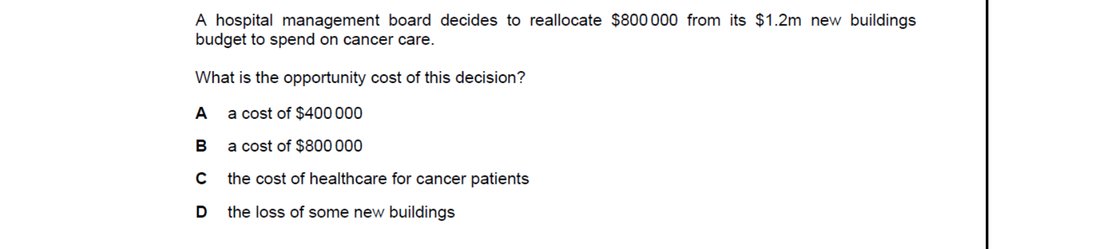
Opportunity cost is the next-best alternative given up. Diverting $800,000 of the building budget to cancer care means some planned new buildings will not be built, so the loss of those buildings is the opportunity cost. Dollar amounts (A, B) describe the value, not the forgone alternative; C describes what was chosen.
1.4What to produce, how to produce and for whom to produce?
The fundamental economic problem leads to three questions every economy must answer about the allocation of resources. Together, the answers determine how the economy works.
- What to produce?
- How to produce?
- For whom to produce?
What to produce?
An economy cannot produce everything it might wish to. It must decide which goods and services to produce and in what quantities. Concretely, this often involves trade-offs between broad categories — consumer goods versus military equipment, current consumption versus investment for the future, public services versus private goods. Different countries make this choice differently, which is visible in the very different shares of national output devoted to defence, healthcare, education and other categories around the world.
How to produce?
Once an economy has decided what to produce, it must decide how to produce it — which combination of inputs to use, which production techniques to adopt, and at what scale. The economic aim is to obtain the most output from the available inputs. The decision is not purely economic, however. Sometimes the cheapest technique raises moral or social concerns — relying on very low-paid labour, for instance, may produce more goods cheaply but at a human cost the society chooses to refuse. Technological choices matter as well: more intensive cultivation methods or better use of available water supplies can substantially raise output from a given resource base.
For whom to produce?
Whatever is produced must be distributed in some way. Should everyone receive a roughly equal share, or should some have much more than others? Different economies answer differently. Some use progressive taxation and transfer payments to redistribute income and wealth from richer to poorer households, with the aim of creating a more equal distribution. Others accept large gaps between rich and poor, often shaped by inherited wealth across generations. Inequality is a particularly significant issue in many emerging economies, where the gap between rich and poor is widening rather than closing.
Key concept link — scarcity and choice
The three fundamental economics questions are typical of a trade-off between economic freedom for firms and individuals and a government that desires greater social equality and fairness.
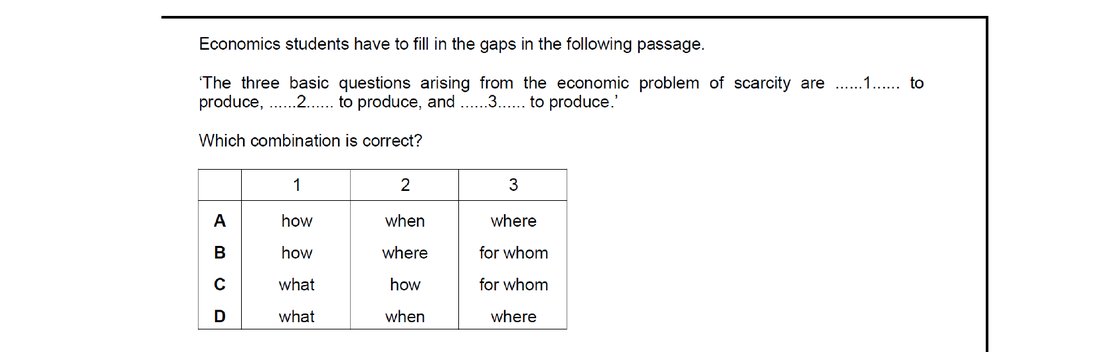
The three basic questions every economy must answer follow from scarcity: what goods to produce, how to produce them, and for whom to produce them. Option C lists exactly this trio.
End-of-chapter practice
Past-paper questions from CIE 9708. Pick A, B, C or D. Answers are saved on this device — press Download report (PDF) at the top to save them.
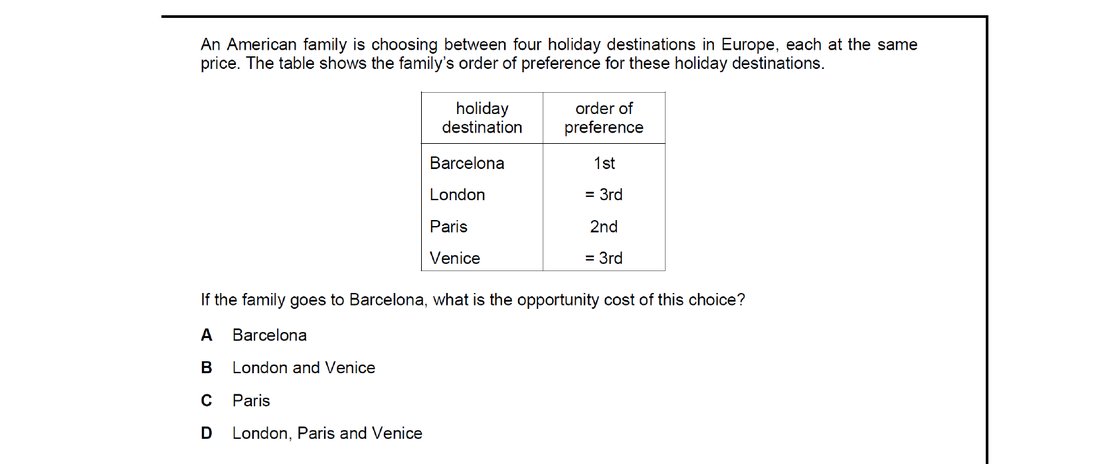
Opportunity cost is the next-best alternative forgone. With Barcelona ranked 1st and Paris 2nd, choosing Barcelona sacrifices Paris — the most preferred forgone option. London and Venice (both 3rd) are less valued and therefore not the opportunity cost.

The opportunity cost of visiting the museum is the value of what she gave up — three hours of wages at $40 per hour = $120 of forgone earnings. The $40 ticket is the price paid, not the opportunity cost of the time itself.
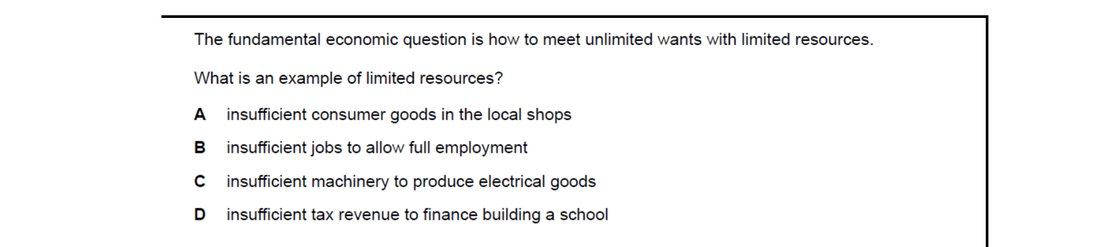
Resources are the productive inputs (land, labour, capital, enterprise) used to make goods and services. Insufficient machinery is a shortage of capital — a genuine productive resource. The other options describe shortages of outputs, employment opportunities, or government finance, not productive inputs.

The opportunity cost of keeping the flute is what she could obtain by selling it now — its resale value of $50. The original $80 paid is a sunk cost and the $95 retail price is irrelevant because she already owns one.
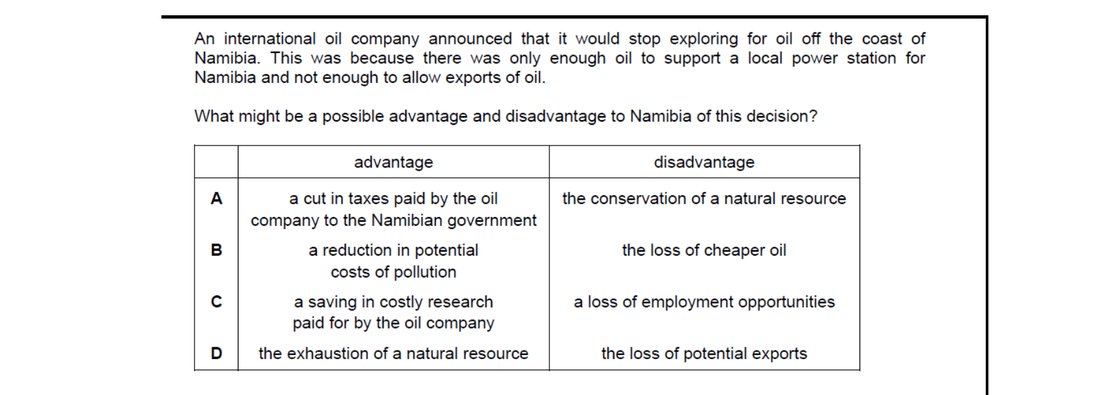
Halting exploration removes the pollution risk of further drilling (advantage) but means Namibia foregoes a cheap local oil supply for its power station and has to rely on costlier imports (disadvantage). Option B pairs these two consequences correctly.
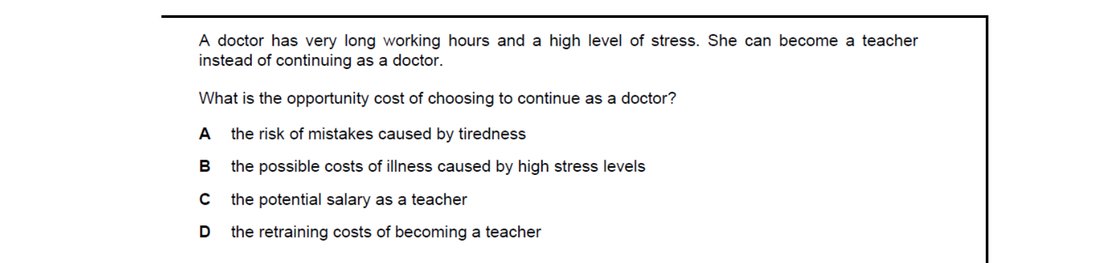
Opportunity cost is the value of the next-best alternative forgone. Staying as a doctor means giving up the teaching career, so the salary she would have earned as a teacher is the opportunity cost. The other options describe drawbacks of being a doctor, not the value of the forgone option.
Attempt the practice questions above to build your score.
Self-evaluation checklist
After studying this chapter, you should be able to:
- Understand why the fundamental economic problem of scarcity occurs.
- Understand why individuals, firms and governments have to make choices because resources are scarce.
- Understand that opportunity cost results from the need to make choices and is the next best alternative that is foregone.
- Analyse why the fundamental economic problem requires all economies to answer three important questions: what to produce, how to produce, for whom to produce.
Want more practice? Drill this chapter's past-paper MCQs (28 questions) →